Crowns & Onlays
Crown vs onlay: what’s the difference?
A crown covers the entire tooth, while an onlay is a more conservative restoration that covers only the damaged areas and key biting surfaces. When suitable, an onlay can preserve more natural tooth structure. The best choice depends on how much healthy tooth remains, your bite forces, and whether cracks or previous restorations put the tooth at risk.
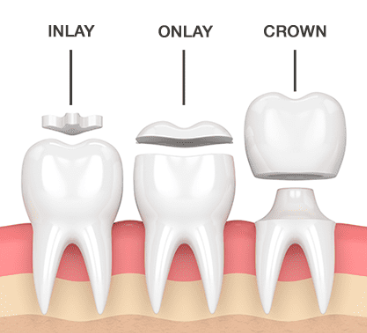
What is the difference?
A crown is a full-coverage restoration that sits over the entire visible part of the tooth, like a cap. An onlay is a partial-coverage restoration that only covers the damaged areas and the biting surfaces that need protection. Both are usually made in a dental laboratory from porcelain or zirconia and bonded or cemented onto the tooth.
The key difference is how much natural tooth structure is preserved. A crown requires the dentist to shave down the tooth on all sides to make room for the restoration. An onlay only requires preparation of the areas that are damaged or weakened, leaving the healthy parts of the tooth untouched.
How do they compare?
| Feature | Crown | Onlay |
|---|---|---|
| Coverage | Full — covers the entire tooth | Partial — covers only the damaged areas and biting surface |
| Tooth removal | More — tooth is shaved down on all sides | Less — only damaged areas are prepared |
| Tooth preservation | Lower — more healthy tooth is removed | Higher — more natural tooth is kept |
| Strength | Very strong — good for heavily broken-down teeth | Strong — but requires enough remaining tooth to bond to |
| Risk to the nerve | Higher — more drilling means more heat and trauma near the nerve | Lower — less drilling reduces the chance of nerve irritation |
| Reversibility | Irreversible | Irreversible, but less tooth is lost |
| Best suited for | Teeth that are very broken down, cracked, or have had root canal treatment | Teeth with moderate damage that still have healthy enamel remaining |
| Longevity | 10–20+ years with good care | 10–20+ years with good care |
| Cost | Similar | Similar |
Why being conservative matters — especially if the tooth still has a nerve
If your tooth still has a living nerve inside it (meaning it has not had root canal treatment), preserving as much natural tooth as possible is especially important. Every time a dentist drills into a tooth, the nerve inside can become irritated. The more tooth structure that is removed, the greater the risk that the nerve may not recover, which could eventually lead to the tooth needing root canal treatment.
An onlay removes less tooth than a crown, which means less heat, less vibration, and less trauma to the nerve during preparation. This gives the nerve a better chance of staying healthy long-term. In simple terms: the less you drill, the better the odds of keeping the tooth alive.
This is why many dentists who take a conservative approach will recommend an onlay over a crown whenever the tooth allows it.
To see how each stage of intervention leads to the next, take a look at the Tooth Death Spiral — it shows why staying conservative early on can save you from bigger problems down the line.
When is a crown the better option?
Onlays are not always possible. They rely on having enough healthy enamel for the restoration to bond to securely. If a tooth is:
- Very broken down with little remaining tooth structure
- Cracked in a way that needs full coverage to hold it together
- Already heavily restored with large fillings on multiple surfaces
- Weakened after root canal treatment
… then a crown may genuinely be the safer and more predictable choice. The goal is not to avoid crowns at all costs, but to make sure one is only placed when it is truly needed.
Questions to ask your dentist
- Does this tooth still have a nerve, and could an onlay help protect it?
- Is there enough healthy tooth left for an onlay to bond to?
- What is the main risk you are trying to reduce with a crown?
- What happens if we take a more conservative approach and monitor instead?
When to seek urgent in-person care
Severe pain, swelling, fever, facial trauma, or bleeding needs urgent assessment.