Orthodontics & Cosmetics
What is the right age for my child to have braces?
Many parents assume braces are for teenagers, but some orthodontic problems are best addressed much earlier — often between the ages of 6 and 10. This is called early interceptive orthodontics. In the right child, at the right time, it can make a significant difference — not just to the teeth, but to facial growth, breathing, and even behaviour. Not every child needs early treatment, but an initial assessment around age 6–8 allows early identification of problems and intervention at the ideal time if needed.
What is early interceptive orthodontics?
Early interceptive orthodontics means:
- Assessing children while they are still growing
- Identifying problems early
- Guiding growth and development rather than trying to correct it later
Instead of waiting for all adult teeth to come through, we work with growth, not against it.
Why not just wait for braces at 12–14?
In some cases, waiting is absolutely fine.
But certain issues are easier — and sometimes only possible — to correct early, while the jaw is still developing.
80% of bone growth occurs in the first 8 years of life.
If we wait too long:
- The jaws may grow in a restricted way
- The face may develop differently
- Outcomes can be compromised as we try to make the teeth fit narrow jaws rather than the jaws grow to fit all the teeth
- Treatment later may become more complex (or even involve extractions or surgery)
How early treatment can help
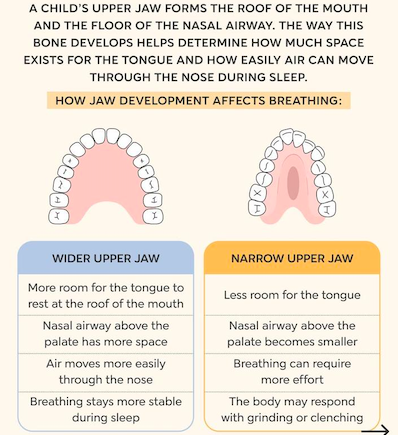
1. Airway and breathing
One of the most important (and often overlooked) areas is the airway.
If a child has:
- A narrow upper jaw
- A high, deep palate
- Mouth breathing habits
This can affect:
- How well they breathe during sleep
- Oxygen levels
- Overall development
Early orthodontic treatment can:
- Help widen the upper jaw
- Create more space for the tongue
- Support better nasal breathing
This can have a positive impact on sleep quality and overall health.
2. Behaviour and concentration
Children who don't breathe well at night may:
- Sleep poorly
- Wet the bed
- Wake up tired
- Struggle with focus and attention
This can sometimes be mistaken for:
- Hyperactivity
- Behavioural issues
- Difficulty concentrating at school
Improving breathing and sleep can, in some cases, lead to noticeable improvements in energy, mood, and focus.
3. Facial growth and development
The way a child's jaws grow affects:
- Their facial shape
- The position of their teeth
- Their long-term oral health
Early intervention can help:
- Guide jaw growth in a more balanced way
- Reduce crowding
- Improve facial harmony
Think of it as guiding growth early rather than correcting problems later.
4. Reducing the need for complex treatment later
When treated early, we may be able to:
- Avoid removing permanent teeth
- Reduce the need for extensive braces later
- Minimise the risk of jaw surgery in adulthood
Signs your child may benefit from early assessment
It's worth having your child assessed if you notice:
- Mouth breathing (especially at night)
- Teeth grinding at night
- Bedwetting
- Snoring or restless sleep
- Crowded or overlapping teeth
- A narrow or V-shaped upper arch
- Thumb sucking beyond age 5–6
- Difficulty chewing or biting
What does early treatment involve?
Early orthodontic treatment is usually:
- Gentle and gradual
- Focused on guiding growth
It may include:
- Expanders to widen the upper jaw
- Simple removable or fixed appliances
- Habit correction (e.g. thumb sucking, tongue posture)
It's not always about full braces at this stage.
For parents looking for more information on early interceptive orthodontics, the Instagram page @toothpillow_official has a lot of very useful and practical content on this topic.
Does every child need early orthodontics?
No — not every child needs treatment early.
Some children:
- Develop normally
- Can safely wait until their teenage years
The key is early assessment, not early treatment for everyone.
When should my child first be checked?
A good time for an initial orthodontic assessment is around age 6–8.
This allows:
- Early identification of problems
- Monitoring of growth
- Intervention at the ideal time (if needed)
My philosophy
I take a preventive and conservative approach:
- Not every child needs early treatment
- But the right child, treated at the right time, can benefit greatly
Because in growing children, small changes early can make a big difference later.
Questions to ask your dentist
- Is my child developing normally for their age?
- Are there any signs of airway or breathing concerns?
- Would my child benefit from early orthodontic assessment?
- What would happen if we wait until they are older?
- Is there anything we can do now to guide their growth?
When to seek urgent in-person care
If you have severe pain, swelling, fever, trauma, or difficulty swallowing/breathing, seek urgent in-person care.