Pain & Infections
When is a root canal treatment necessary?
A root canal treatment is necessary when the nerve (pulp) inside a tooth becomes irreversibly damaged or infected. This can happen because of deep decay, a crack, repeated dental work, or trauma. The treatment involves removing the infected nerve tissue, cleaning and shaping the inside of the root, and sealing it to prevent reinfection. Understanding when it’s truly needed — and what increases your risk — can help you make better decisions about your dental care.

"Studies are now showing links between dental infections and many chronic diseases including heart disease and autoimmune conditions. It is therefore very important to address any dental infections, even if they are not causing any pain."
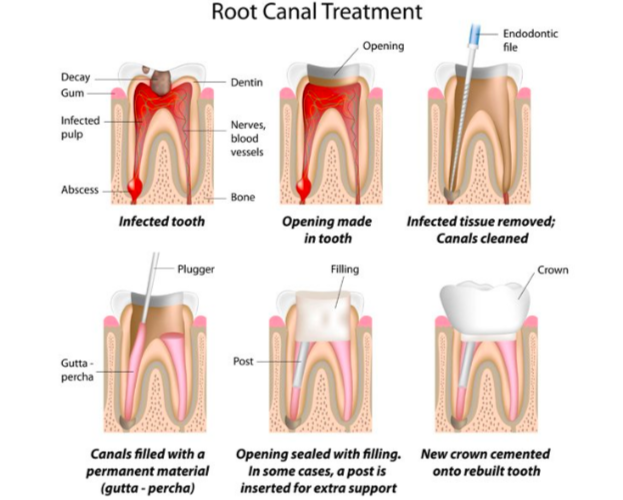
What does a root canal treatment involve?
Inside every tooth is a soft tissue called the pulp, which contains nerves and blood vessels. When this tissue becomes infected or dies, a root canal treatment removes it, cleans the hollow canals inside the root, and seals them with a filling material. The tooth is then usually restored with a crown or large filling to protect it from fracture.
When is it necessary?
A root canal treatment is typically needed when:
- The nerve is irreversibly inflamed (irreversible pulpitis) — causing lingering, throbbing pain that doesn’t settle
- The nerve has died and an infection (abscess) has formed at the tip of the root
- A tooth has suffered trauma (e.g. a knock) that has damaged the nerve beyond recovery
- Deep decay has reached the pulp and bacteria have entered
Why more invasive dentistry increases the risk
Every time a tooth is drilled, the nerve inside is stressed. A small filling may cause no lasting damage, but the more tooth structure that is removed — for example with a deep filling, a crown, or a veneer that requires significant shaving — the closer the drill gets to the nerve and the greater the trauma. This is one of the key reasons why minimally invasive dentistry matters: the less you drill, the lower the chance the nerve will be pushed past the point of no return. See the Tooth Death Spiral infographic to understand how each round of treatment moves a tooth closer to extraction.
Can an infected tooth be painless?
Yes — and this catches many people off guard. When the nerve inside a tooth dies, the pain can actually stop because the nerve is no longer sending signals. But the infection doesn’t go away. It quietly spreads into the bone around the root tip, forming an abscess that may only show up on an X-ray. This matters because chronic dental infections have been linked to inflammation elsewhere in the body, and in rare cases can spread to other areas such as the sinuses, the throat, or even the bloodstream. A painless tooth is not necessarily a healthy tooth.
Studies are now showing links between dental infections and many chronic diseases including heart disease and autoimmune conditions. It is therefore very important to address any dental infections, even if they are not causing any pain.
How successful is root canal treatment?
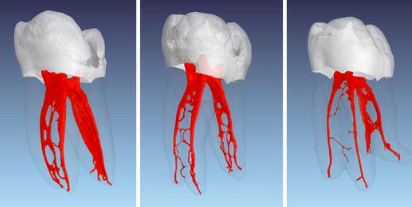 Root canal treatment, when performed well, can be very successful and allow you to keep a tooth for many more years. However, as you can see from the image above, the anatomy inside a tooth is far more complex than most people realise. Beyond the main canals, there are countless tiny lateral (accessory) canals branching off in all directions. These microscopic branches are impossible to fully clean and sterilise during treatment, which means some bacteria will always remain. This is not a failure of the treatment — it is simply the reality of dental anatomy. It is also why it is important to have root-filled teeth monitored regularly by a dentist, usually with periodic X-rays, to check for any signs of recurrent infection. Early detection of a problem gives you the best chance of saving the tooth or managing it before it becomes a bigger issue.
Common alternatives
- Careful monitoring for reversible pulpitis (where the nerve may recover)
- A temporary medicated filling in select cases to see if the nerve settles
- Extraction — when the long-term prognosis of the tooth is poor
Questions to ask your dentist
- Is this reversible or irreversible pulpitis?
- What is the long-term prognosis of this tooth with and without treatment?
- Could a less invasive option protect the nerve?
When to seek urgent in-person care
Swelling, fever, spreading infection, or difficulty swallowing/breathing is urgent and should not wait.