Understanding Treatment
Crowns vs Veneers: What's the Difference, Which Is Better, and How to Choose
Crowns and veneers serve different purposes. Learn when each might be recommended and what to consider before making a decision.

"Every restoration has a natural lifespan. Good dentistry is about managing that lifespan carefully — not just improving how a tooth looks today, but protecting it for the years ahead."
When a dentist recommends a crown or a veneer, it's completely normal to wonder:
- Which one is better?
- Is one more conservative?
- Will one last longer?
- Is this cosmetic — or actually necessary?
The answer isn't about which treatment is "best" overall. It's about what this particular tooth needs.
What Is a Dental Crown?
A crown is a restoration that covers the entire visible part of a tooth — like a protective cap.
It is usually recommended when:
- The tooth already has large fillings
- There is a crack or high fracture risk
- A root canal treatment has been done
- The tooth structure is significantly weakened
Because a crown wraps around the whole tooth, some healthy tooth structure has to be reshaped to make space for it.
However, in return, the tooth gains strength and protection.
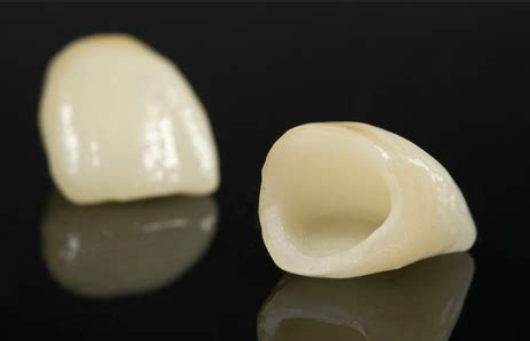
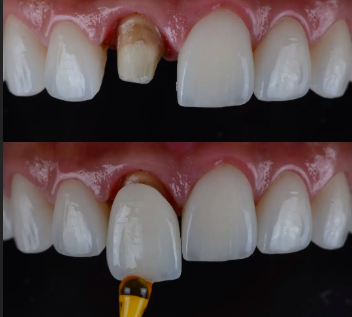
Crowns are mainly used to reinforce and protect a tooth — not just improve how it looks.
What Is a Veneer?
A veneer is a thin ceramic layer bonded to the front surface of a tooth.
It is usually used when:
- The tooth is structurally healthy
- The main goal is improving appearance
- There is mild discolouration, small alignment issues, or shape concerns
Veneers are generally more conservative than crowns because less tooth structure is removed.
But veneers do not strengthen a weak tooth.
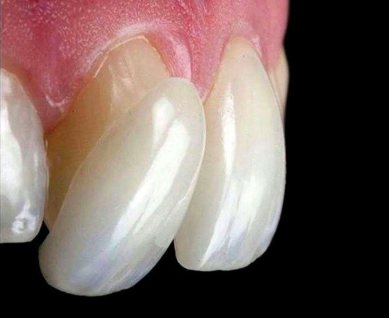
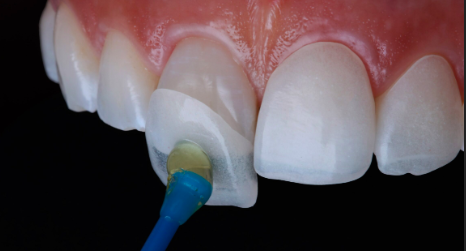
If a tooth is already damaged or heavily filled, a veneer may not be the safest long-term option.
The Core Difference
| Feature | Crown | Veneer |
|---|---|---|
| Coverage | Entire tooth | Front surface only |
| Tooth reduction | More | Less |
| Structural support | Yes | No |
| Main purpose | Protection + strength | Aesthetic improvement |
| Best for | Heavily restored or weak teeth | Healthy teeth needing cosmetic change |
The real question is not "Which is better?" It's "What does this tooth actually need?"
Crown Materials: E-max vs Zirconia
Most modern ceramic crowns are made from either:
- E-max (lithium disilicate)
- Zirconia
Both are strong, modern materials — but they behave differently.
E-max (Lithium Disilicate)
- Very natural-looking and translucent
- Mimics enamel beautifully
- Strong, though slightly less strong than zirconia
- Can be seen through on X-rays
Because E-max allows some X-ray visibility, dentists can usually see what is happening underneath the crown.
It is often chosen for front teeth where appearance matters most.
Zirconia
- Extremely strong and durable
- More opaque (less translucent / natural looking than E-max)
- Often used for back teeth under heavy chewing forces
- Cannot be seen through clearly on X-rays
Zirconia is very dense on X-rays. This means it can block the view of the tooth underneath.
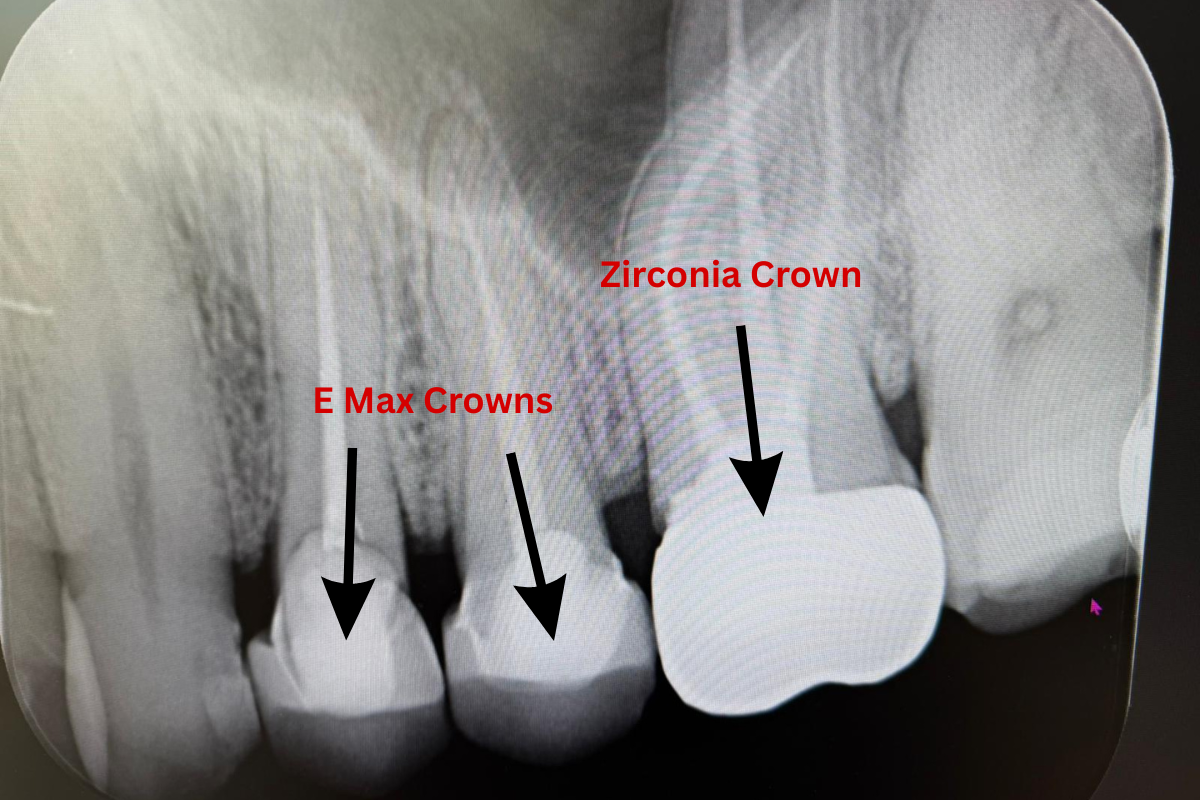
Why Does X-Ray Visibility Matter?
With E-max, dentists can often detect:
- Early decay forming under the crown
- Cement breakdown
- Changes in the surrounding bone
With zirconia, because the material is so radiopaque, it can hide early changes underneath.
This does not mean zirconia is bad. It is widely used and very successful.
However, there are some important long-term considerations:
- Decay under zirconia crowns is often harder to detect early
- The risk is higher if zirconia crowns are linked together (for example, in bridges), because cleaning is more difficult and cement can weaken under pressure
- Problems often only become visible when they are more advanced
- In advanced cases, this can mean an unexpected need for root canal treatment — or, in severe situations, tooth loss
For patients who are prone to decay, this is worth discussing before choosing materials.
Material choice should consider:
- Bite strength
- Decay risk
- Aesthetic needs
- How easily the tooth can be monitored long-term
There is no universally "best" material — only the best material for the specific situation.
When Veneers Can Become Risky
Veneers are sometimes promoted as the solution for everything.
But they are not appropriate when:
- The tooth already has large fillings
- There is significant structural loss or poor enamel to bond to
- The bite is unstable
- There is untreated grinding
In such cases, a crown — or often orthodontic (braces) treatment first — may be the more biologically sensible choice.
The goal is stability first, aesthetics second.
Important Questions to Ask
Before proceeding, it's reasonable to ask:
- Is this tooth structurally weak or mainly cosmetic?
- How much natural tooth will be removed?
- Why are you recommending E-max or zirconia?
- How will this be monitored over time?
- What happens when it eventually needs replacing?
Every restoration has a lifespan. Good dentistry is about managing that lifespan thoughtfully.
A Final Thought
Crowns and veneers are tools — not upgrades.
The most conservative and long-lasting treatment is usually the one that:
- Respects healthy tooth structure
- Works with your bite
- Is planned for the long term
The aim isn't just to make a tooth look better today. It's to protect it for years to come.