Veneers
Bonding vs veneers: which should I choose?
While numerous options exist to enhance your smile, each comes with its own set of advantages and disadvantages. The choices you make today significantly impact your long-term oral health. This is particularly crucial if your teeth are currently young and healthy; selecting the right treatment plan now is essential to preserve them for a lifetime.
Understanding the difference
Bonding involves adding tooth-coloured composite resin directly onto your teeth to improve their shape, close gaps, or repair chips. It is usually additive, meaning little or no natural tooth is removed. Porcelain veneers are thin shells bonded to the front of the teeth. They tend to offer a higher-end cosmetic result and are more resistant to staining than composite bonding. The process is usually irreversible because some enamel is removed. Completely non-prep veneers may be an exception.
Patient examples
Composite bonding

Three months after composite bonding to close a gap between front teeth. Published case by Toumaj et al., Figure 11 · CC BY 4.0.
Veneers

Front teeth before and after veneers. Clinical photos by Yvul, Wikimedia Commons · CC BY-SA 4.0.

Comparing bonding and veneers
| Feature | Bonding | Non-Prep Veneers | Minimal-Prep Veneers |
|---|---|---|---|
| Cost | Lower — typically a fraction of the cost of veneers | Higher — lab-made porcelain, similar to standard veneers | Higher — lab-made porcelain is more expensive |
| Aesthetic result | Good — natural-looking but may stain or dull over time | Very good — colour-stable porcelain, though can look slightly bulkier as no enamel is removed | Excellent — highly polished, colour-stable porcelain |
| Maintenance | May need polishing or touch-ups every few years; more prone to staining from tea, coffee, and red wine | Generally low maintenance but if chipped or cracked, the whole veneer usually needs replacing | Generally low maintenance but if chipped or cracked, the whole veneer usually needs replacing |
| Longevity | 3–7 years typically before touch-up or replacement | 10–15+ years with good care | 10–15+ years with good care |
| Risk to teeth | Very low — usually no drilling or minimal enamel removal; often reversible | Very low — no enamel removed at all; potentially reversible | Moderate — requires permanent removal of enamel; irreversible |
What about non-prep veneers?
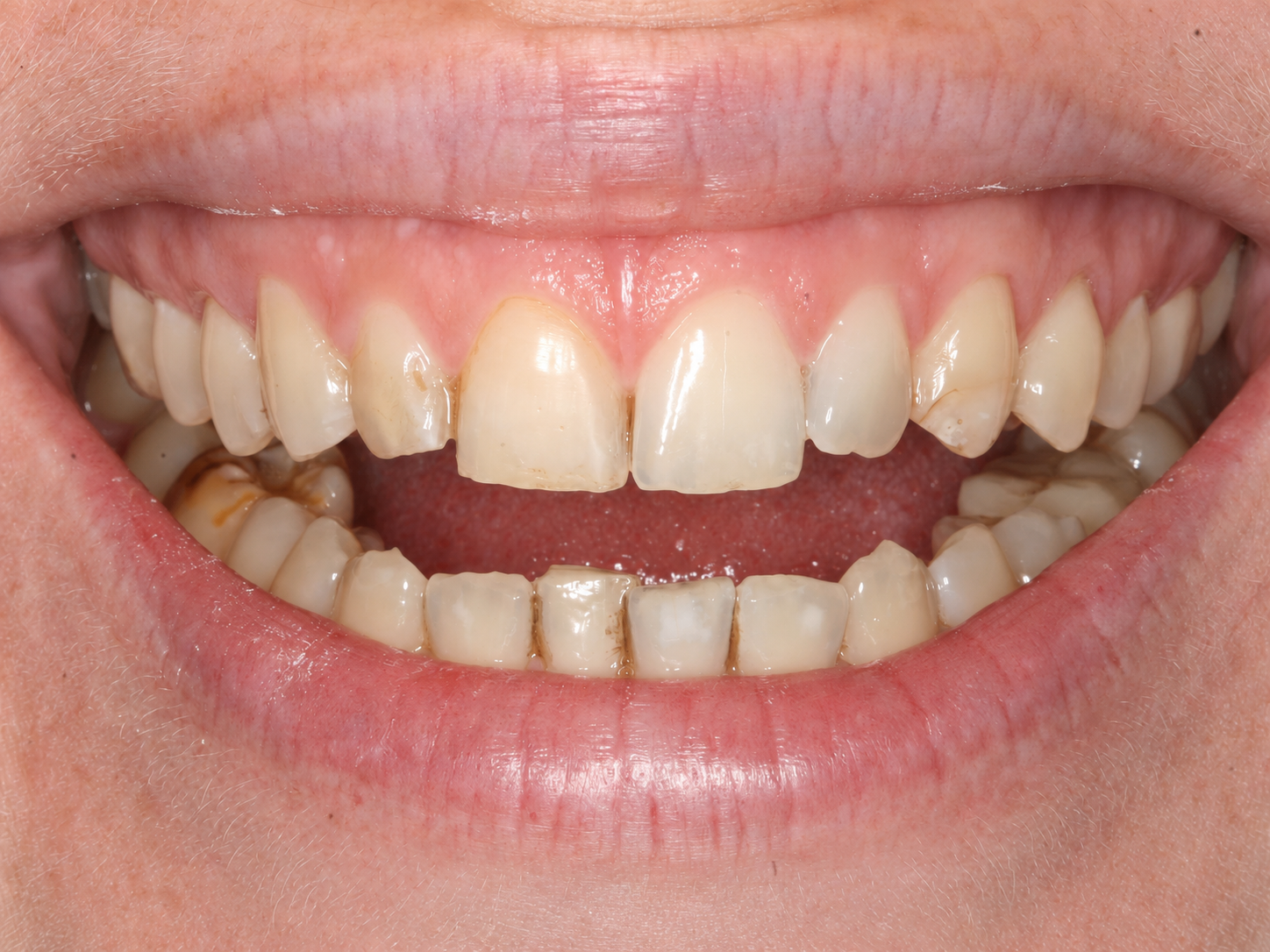
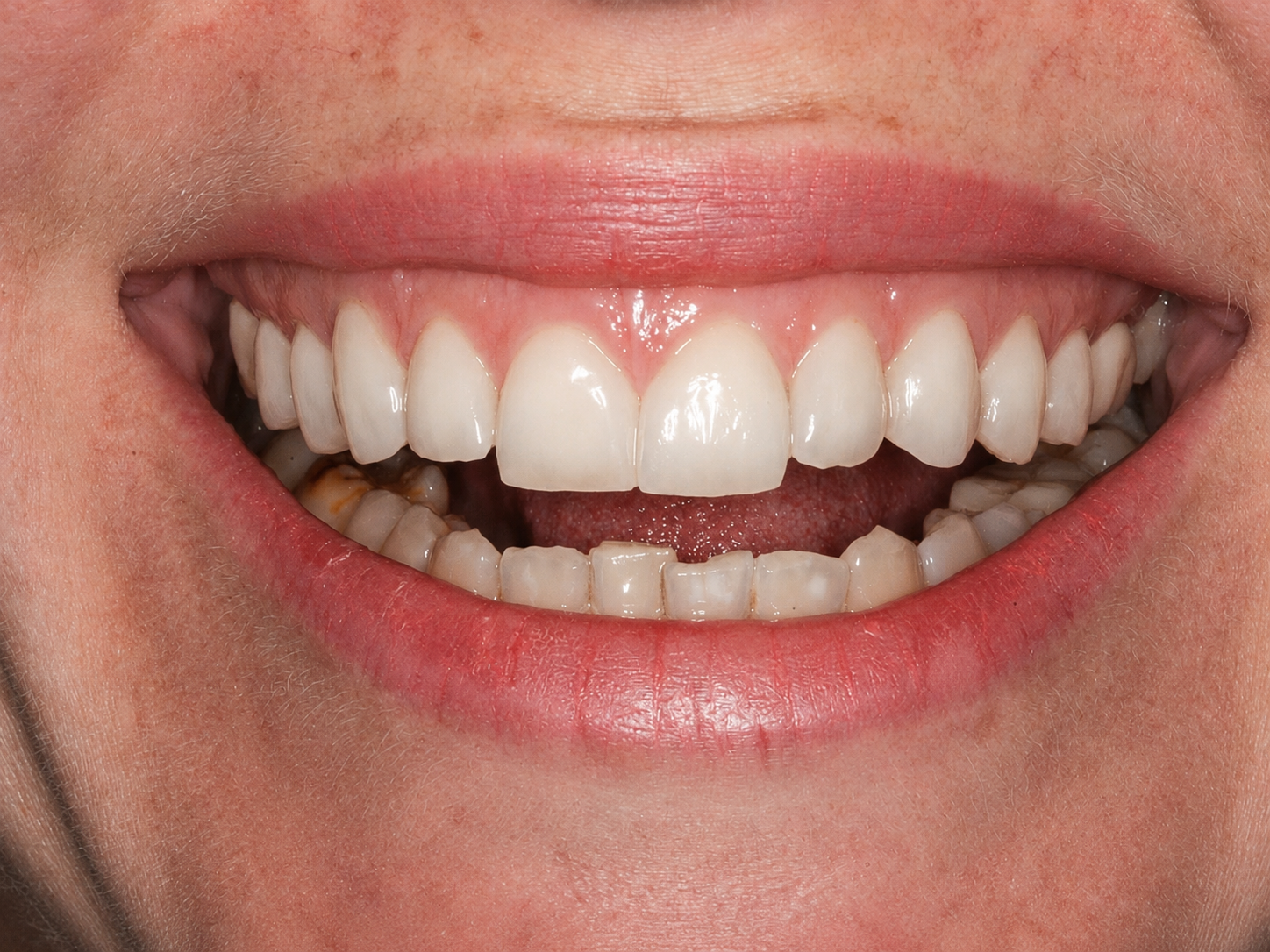
In rare cases, some patients may be good candidates for non-prep (no-shaving) veneers. These are very thin porcelain shells bonded to the front of the tooth without removing any enamel at all. They work best when the goal is to add length, close small gaps, or improve shape on teeth that are already well-positioned and not heavily discoloured.
The images below show a real patient before (left) and after (right) non-prep veneers:
Pros of non-prep veneers
- No drilling or enamel removal — the process is potentially reversible
- Less sensitivity during and after treatment
- A more conservative option for patients who want porcelain aesthetics without permanent tooth changes
Cons of non-prep veneers
- Not suitable for everyone — they add thickness to the tooth, so they can feel bulky if teeth are already prominent or crowded
- Limited ability to change tooth colour if the underlying tooth is very dark
- May not last as long as traditional veneers in some situations
- Require very precise bonding technique to avoid problems at the edges, risking potential gum problems and cavities
If you would prefer an even more conservative, tooth-preserving alternative to veneers, read about Align, Bleach and Bond — a combined approach that gently straightens, whitens and reshapes teeth with little or no drilling.
Can old veneers be removed with a laser?
At Alma Polyclinic, we offer laser-assisted removal of old porcelain veneers. When suitable, the laser helps release the bond between the veneer and the tooth, with the aim of preserving as much of the underlying tooth as possible. We’ll assess your veneers and teeth first to see whether laser removal is an option for you.
Clinical reference on laser-assisted ceramic veneer removal
Questions to ask your dentist
- Can we try bonding first before committing to veneers?
- Am I a candidate for non-prep veneers?
- Can we do a reversible “trial smile” first?
- What will this look like in 5–10 years?
When to seek urgent in-person care
Severe pain, swelling, fever, or trauma require urgent assessment.